Tehnilised Dokumendid
Spetsifikatsioonid:
Brand
BroadcomProduct Type
Optocoupler
Mount Type
Surface
Number of Channels
1
Number of Pins
8
Typical Rise Time
1.7μs
Maximum Input Current
230mA
Minimum Operating Temperature
-40°C
Maximum Operating Temperature
105°C
Typical Fall Time
1.7μs
Standards/Approvals
RoHS
Series
ACNT-H79B
Automotive Standard
No
Päritoluriik
Philippines
Toote üksikasjad
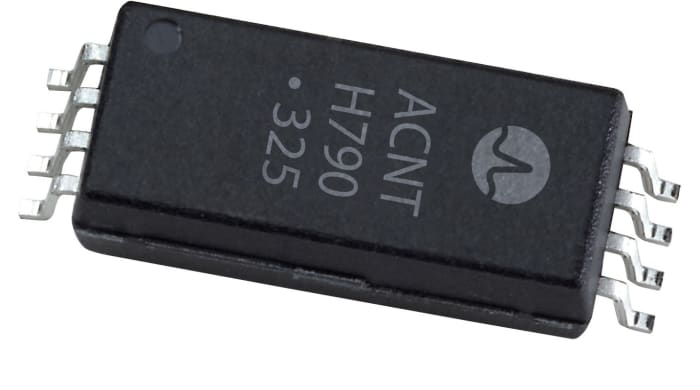
The Broadcom ACNT-H79B isolation amplifiers are designed for current and voltage sensing in electronic power converters for applications including motor drives and renewable energy systems. In a typical motor drive implementation, current flows through an external resistor and the resulting analog voltage drop is sensed by the isolation amplifier. A differential output voltage that is proportional to the current is created on the other side of the optical isolation barrier.
Lao andmed ajutiselt ei ole saadaval.
€ 17,10
€ 17,10 tk (ilma käibemaksuta)
€ 21,20
€ 21,20 tk (koos käibemaksuga)
Standard
1
€ 17,10
€ 17,10 tk (ilma käibemaksuta)
€ 21,20
€ 21,20 tk (koos käibemaksuga)
Lao andmed ajutiselt ei ole saadaval.
Standard
1
| kogus | Ühikuhind |
|---|---|
| 1 - 9 | € 17,10 |
| 10 - 49 | € 14,80 |
| 50 - 79 | € 12,20 |
| 80+ | € 11,00 |
Tehnilised Dokumendid
Spetsifikatsioonid:
Brand
BroadcomProduct Type
Optocoupler
Mount Type
Surface
Number of Channels
1
Number of Pins
8
Typical Rise Time
1.7μs
Maximum Input Current
230mA
Minimum Operating Temperature
-40°C
Maximum Operating Temperature
105°C
Typical Fall Time
1.7μs
Standards/Approvals
RoHS
Series
ACNT-H79B
Automotive Standard
No
Päritoluriik
Philippines
Toote üksikasjad
The Broadcom ACNT-H79B isolation amplifiers are designed for current and voltage sensing in electronic power converters for applications including motor drives and renewable energy systems. In a typical motor drive implementation, current flows through an external resistor and the resulting analog voltage drop is sensed by the isolation amplifier. A differential output voltage that is proportional to the current is created on the other side of the optical isolation barrier.